.

.

Friday, August 5, 2016

Summer in Oklahoma: It's SO Hot Outside...

.... that the chickens are laying hard-boiled eggs!

... that corn is popping on the stalk!

... that the fire hydrants are chasing down the dogs!

... that the cows are giving evaporated milk!

Okay, these are getting a little ridiculous, I admit it.
The point, obviously, is that it is HOT OUTSIDE this summer in Oklahoma!   Of course, this summer is no different than any summer in Oklahoma - it gets hot and stays hot, and the plants begin to wilt and brown and go dormant and die.
What's the use of trying to have a lovely garden in Oklahoma in the summer?!

Actually this is only partially true.
Will Rogers Gardens, OKC - Sweet Potato Vine, Crape Myrtles,
Cannas, Castor Bean Plant, and etc.
The secret to gardening in Oklahoma summers is to have the right plants, usually perennials.
And there are surprising number of plants that will not only survive Oklahoma summers but also THRIVE and blossom!

I've been trying to start early and finish early while gardening in this crazy heat and humidity.  I find myself dripping and wilting by about 9 AM every day.
Today was a short gardening day... by the time the drips started just before 9 AM, I was finishing up the job.  Since the day was overcast (but still so humid), I decided to do a little photography in the garden of my client and then in a botanical garden near my home.

I think I walked around shooting photos for about 20 minutes, and by the time I was done, I was DONE!  It amazed me to feel the way I did - absolutely overcome by the humidity - when the flowers around me were so fresh and bright and loving the heat!

For those of you who have wondered what to plant in Oklahoma gardens that will thrive in the summer, here is a visual list of some of the plants I see time and again in the gardens of my clients - they always seem to do well in our heat, and most of them survive our Oklahoma winters and come back the next year, strong as ever.

I'm not sure about other areas, but if your weather is similar to Oklahoma, these might work for your garden too.

From here on out, I'll let the plants speak for themselves, and I'll just include the names of the plants.

Jenn's Garden - Black-eyed Susan
For the record, I took all of these photos today either in Will Rogers Gardens (a botanical garden in Oklahoma City) or in the garden of my friend Ida Pulaweed.  (Actually her name is Jennifer, but she did not necessarily care one way or the other if her name was put up in lights for all to see.) 


Jenn's Garden - Cyrpres Vine


Jenn's Garden - Hyrdrangea, Cyrpress Vine, Petunia
Will Rogers Gardens - Purple Heart & Dwarf Daylily


Will Rogers Gardens - Lantana & Ornamental Grass
Will Rogers Gardens - Sedum/Stonecrop


Will Rogers Gardens - Canna
Will Rogers Gardens - Caladium (shade-loving) and Nandina


Will Rogers Gardens - Cleome 


Will Rogers Gardens - Zinnia


Will Rogers Gardens - Crape Myrtle
(good old Oklahoma standby)
...also in pale purple


... or white
...or hot pink
Will Rogers Gardens - Texas Red Yucca &
Purple Heart


Will Rogers Gardens - Portulaca/ Rose Moss


This is the end of the visual list but by no means is it the end of the list of plants that absolutely thrive in and love Oklahoma summer heat!

Before I sign off and go eat some ice cream to cool off, let me ask you if that last plant looks or sounds familiar?
Remember "Pursy"?  A Love Song to Purslane?
(no, it's not an obscure long-lost song from the Beatles)

Rose Moss Portulaca is the ornamental form of the common "weed" form of Purslane (Portulaca oleracea)...the edible weed!  Check out the blog post to find out more.  It's yummy!

Here's one final parting shot of some of the temporary residents of Will Rogers Gardens who also don't mind the heat...


Okay, ice cream calls!  Time to brave the heat and drive home.

Happy gardening this summer, wherever your summer garden may be!
(and for those in the Southern hemisphere - happy winter gardening!)

Wednesday, August 3, 2016

A Love Song to Purslane

Oh Pursy...

How do I love you?
Let me count the ways...

Okay, I'll stop right there before I begin plagiarizing Elizabeth Barrett Browning's Sonnets From the Portuguese 43.

Purslane - edible weeds
Purslane with tiny beautiful flowers that open for a very short time every day.
Really though (all you Americans pay attention now)... have you ever stopped to consider the beautiful and prolific Purslane growing under your foot?

I'm sure the Europeans and Mexicans and Aussies and etc reading this post will say, "yes, Purslane is yummy and so nutritious!"

Americans are probably saying "you mean that weed I can't seem to get rid of that takes over my garden every summer?  It's EDIBLE?"

Yes!!

Not only that but it is one of the most nutritious vegetables you can eat!  And every part of it is edible... even the tiny thousands of black seeds are edible.

Go ahead.... I know you want to... you cannot contain your curiosity.  Go ahead and Google "Purslane edible" or "buy Purslane" or "how to use Purslane".  You'll be amazed!

Do I have your attention yet?  Good!  And since now is the perfect time to consider Portulaca oleracea - otherwise known as Purslane, at its prime in the heat of summer (unless you live in the Southern hemisphere), get out there and get to looking around for some Purslane to salvage, pamper, and propagate!

You should be able to find it just about anywhere - definitely everywhere in Oklahoma.  Look for a low-growing, radiating from central point, succulent plant with a red tint to the stems and clear liquid when the stems are broken open.  It could be/should be/most likely will be found growing in cracks in sidewalks, in dusty isolated lots, wedged in between plants in gardens, forcing its way in to just about every unused inch of space.

Before you start stuffing this on-purpose "weed" into your mouth, be ABSOLUTELY sure it is NOT the dangerous imposter, highly poisonous, known as Spurge.

Spurge is NOT a succulent. Spurge has white milky liquid when the leaves are broken.  But Spurge can make itself look like Purslane at first glance, with the same small oval green leaves and radiating growth pattern.  Spurge is poisonous!!  Do not eat!!

Purslane - clear liquid when broken - GOOD!
milky sap from Spurge signals "poisonous"
Spurge- milky liquid when broken - BAD!

Let's take a look at some photos for plant-identification practice...

Here is an example of Purslane taking every available inch... in the foreground growing in the crack between sidewalk and border, on the left growing in the bed  with the sedum.  The sedum (another succulent - not sure about how edible it is) can be seen mostly on the right and center in the photo.  Can you tell the difference?


Here is a look at a Spurge plant growing in the dry Oklahoma dirt.

Notice the radiating pattern and the red tint to the stems.

Can you tell the difference between this plant and the Purslane above?


Look below for one more practice photo.


Purslane versus Spurge - tell the difference
This photo has Spurge and Purslane growing intermingled.  

Can you tell which is which?
Can you spot the Spurge?

Just remember.... 
"Spurge = scourge... 
                   Do NOT eat!"


One more sample of Purslane.  This one is growing from the crack in the sidewalk just outside my apartment.

Remember, both Purslane and Spurge can have a red tint to the stem.

If unsure, break off a piece.
Milky liquid? DO NOT EAT!

Clear liquid?  Enjoy!

And if you shake a stem over your hand, Purslane should release lots of tiny black seeds.


baby Medjool date tree

Oh, I almost forgot!

Here's one more fun look at Purslane.
It is one plant growing from the side drain hole in a container.
I've been harvesting from it regularly, but it just grows and grows!

Do you recognize the baby plant in the top of the container?

It's Medjie!
(from a previous post - "Shh...The Elephants Are Sleeping!")

See how much he has grown?!
And still so cute!


So...are you convinced yet?
What's not to love about Purslane!?

Now that I've been writing about it, I'm having a craving for some Purslane with scrambled eggs and cheese and tomatoes.

If you'll excuse me - I need to step outside and do a little harvesting....

Happy eating those wonderful edible weeds!


Monday, November 30, 2015

Have You Seen This Plant!?

             ...viciously torn from its happy garden home!


It was a dark and stormy night... [thunder crashes; the corner street lamp flickers off and on; a dog barks in the distance; the muffled "shhhnk" of a shovel sunk into rich soil; silent screams from trembling plants; large, round, glowing-gold eyes appear menacingly in the window...]


Mr I. Ben Robbed and his wife M.B. Myplants, our heroes, were happily tucked in under the covers, enjoying a good night's dreamy sleep, while their black panther, Onyx the Supervisor, snored cozily at the foot of the bed.
(Really she's a house cat - not a panther...but she thinks she's a panther.)

Suddenly a loud clanging, nerve-jangling clamor jerked them all from their pleasant slumber....the sound of the alarm clock going off.  Time to get up and see what damage the storm left in its wake.

As Mr. I.B.R made the rounds, admiring his gardens, stopping to smell the...um...the...abelia (he has no roses), stooping to say hello to the clover growing in the grass, dodging the occasional falling torpedo (catalpa seed pod), marveling at the new growth on the trailing forsythia (that's another story), he suddenly noticed something that was cause for pause.

Actually it was what he didn't notice that brought him to a stop in his tracks.
He didn't notice his hydrangeas...not all of them.

He did a double-take, and then a complete back-track. Rushing to the spot where he had just recently carefully and lovingly nestled his two baby hydrangea plants, he noticed instead two very empty, very newly dug holes.  In fact, it looked like they had just been ripped violently from their beds!

Ahhhhh!!  Who would do such a thing?!?  In broad moonlight?  In a garden fully visible from the street?  On a fairly busy corner?  Directly under a bright street lamp?  With Onyx the panther glaring menacingly from the window just a few feet away?

Who would just rip two baby hydrangea plants out of the garden like that?

Mr. I. Ben Robbed cried out (at least inwardly) exactly what he should cry out at a time like this:

"I've been ROBBED!!"

His wife, hearing his pained cry, sprang from the bed to see what was the matter,
Away to the window she flew like a flash,
Tore open the shutters and threw up the sash.
When what to her wondering eyes should appear?
But a miniature sleigh and eight tiny....
Oh wait!  Sorry.  Getting a little carried away.

When Mr I. Ben told her the whole sad story, she let out her own cry of anguish: "Ohhhh... them are My Plants!"

Onyx the Supervisor heard the commotion and sauntered over to inspect the issue.
She took one look at the two empty hydrangea beds, pillows scattered and covers all askew, and looked up and said "Mrrangh."  (She doesn't really meow very well, but the supposed translation is something to the effect of "I watched the whole thing happen from the window and tried to alert you, but no one ever listens to me!").

Mr Robbed and Mrs Myplants spent the next few hours grilling the neighbors for any leads and scouring the garden for any clues.
Surely someone (besides the very helpful but verbally-challenged Onyx) heard something!

Alas, it was no use.
They eventually turned to grilling a chicken for lunch and scouring the grill they cooked it on, resigning themselves to the fact that they would never know WHO stole their precious baby hydrangeas.  Or HOW someone could stoop so low.  Or WHY a person (or perhaps a whole gang of hydrangea thieves) would do such a thing.
Mr. Robbed thought of contacting the police to track down the hydrangeas, but he realized that sadly he had no leaf-prints or dental records, not a trace of DNA from his two babies.

They consoled themselves as best they could, taking comfort in the fact that the remaining garden plants were unhurt and relatively unaffected by the whole matter.

It was not long after this that I came on the scene.
Mr Robbed showed me the sad and empty hydrangea bed where the two siblings had been snoozing that fateful night.

Having been the one to do the actual physical planting of the two babies in the garden not long before that, I was understandably aghast and distraught at such an appalling act.
I vowed to do all in my power to track down and rescue those two hydrangea babies.

So I hired an age-progression expert artist who also loves to garden.  Based on the description given to her by our brave heroes, this is the picture she came up with:


Please take a close look, and if you recognize this plant or if you see it while you are out and about, strolling through gardens, please contact me and I will pass the information along to the appropriate authorities.

Together, we can make a difference for this family!


(I hope you enjoyed this story and the hydrangeas that took center stage, or rather that didn't appear on stage at all.  Just one important clarifying note for those readers who might take this a little too seriously...please don't really send me any leads or information regarding possible sightings of these plants!  Thanks!)


Sunday, August 30, 2015

Compost By Any Other Name...

...could put the burn on your plants!


Yes, this post goes in the category of "Lessons Learned" (sometimes the hard way)...but then it all works out in the end.  Yay!

So now that you know the story ends happily, are you ready to hear (read) a story?
And this time the story really does pertain to the post.
In fact, the story IS the post!


Here's how it goes...

I was "talking shop" (gardens) with someone recently.
We'll call him I.B. Anonymous.

Mr Anonymous told me this story, and I just knew that so many of us could learn from his experience, so I begged him to let me take photos of his garden.
Actually no begging was needed.  He was quite happy to be featured in my blog (as long as his identity remained unknown)!

He and his dw (we'll call her Ima Hiswife, sometimes hyphenated as Hiswife-Anonymous) have recently moved into a brand new home with brand new gardening spaces just waiting to be developed.
So they have been developing gardens and putting in plants.

The back lawn is a split level with a stone retaining wall separating the two levels.
You'll see it in the photo.

Mr. Anonymous had this great idea (I've heard brilliance is a common trait in his family).  He decided to build two raised beds for veggies and such, each about 6 feet by 2 feet, butting right up against the retaining wall on the top level of the lawn.  That way he could stand on the lower level of the lawn and work in the raised beds without bending down.  Since the beds are only two feet wide, he can reach the far side of the bed with no problem.  The ears on my aching gardener's back perked up at this idea!
(Okay, I don't really have ears on my back, or eyes in the back of my head for that matter.  
Just clarifying for those of you who are very literal.)

He built the beds using 2 x 6 x 8 pieces of lumber, stacked two boards high.
You'll see it in the photo.

After laying landscape fabric on the lawn and installing the two raised beds, he then filled the beds with a mix he made himself, based on a recipe he found on a gardening website he recommends.
The website is called My Square Foot Garden, and the name of the recipe is Mel's Mix.

Basically, the recipe goes like this:

          1/3 vermiculite
     1/3 peat moss
     1/3 compost (as many types as you can find)

Before we continue with the story, I want to pause for a quick "learning moment" interlude.
You might be asking the same question that I've always wanted to ask and finally asked while
typing this post..."what the heck is vermiculite anyway?"

I've always heard of it and seen it as an ingredient in things like potting soil or potting medium.
But I never stopped to ask what it was exactly...until now.

Here is what Wikipedia, the free encyclopedia, has to say about vermiculite:
Vermiculite is a hydrous phyllosilicate mineral.
It undergoes significant expansion when heated. Exfoliation  occurs when the mineral is heated sufficiently, and the effect is routinely produced in commercial furnaces. Vermiculite is formed by weathering or hydrothermal alteration of biotite or phlogopite.
Large commercial vermiculite mines currently exist in Russia, South Africa, China and Brazil.

Okay, so I'm sorry I asked!
No, not really.  Let's pretend we're tech writers and turn this gobbledy-gook into English.

Wikipedia goes on to offer some of the common applications of vermiculite...

*moulded shapes for high heat areas such as fireplaces
*packing material for explosives storage
*commerical hand warmers
*used to absorb hazardous liquids for solid disposal
*a substrate for various animals and/or egg incubation
*brake linings
*a loose-fill insulation

and here is our interest in the stuff....

*Soilless growing media: exfoliated vermiculite is combined with other materials such as peat or composted pine bark compost to produce soilless growing media for the professional horticulturalist and for the home gardener. These mixes promote faster root growth and gives quick anchorage to young roots. The mixture helps retain air, plant food and moisture, releasing them as the plant requires them.  Exfoliated vermiculite is also used as a growing media for hydroponics.


So this stuff helps retain moisture, provides aeration, and helps break down heavy compacted soils.

Just from a quick perusal of the Wide Wild World of the internet, I discovered many brands of vermiculite available for purchase in many quantities from tiny bags to huge bulk sizes...found at most big box home improvement stores as well as smaller "mom and pop" nurseries and feed stores.

Ah, but I digress!

This post is not meant to be focusing on the first ingredient in this soil-less mix, but on the third ingredient - COMPOST!

(At least now we know what vermiculite is, even if we can't say it properly!)

Okay, back to the story ... and the recipe.

So Mr Anonymous decided, after reading the blog post about soil-less mixes working well for raised bed gardens, that he would use Mel's Mix for his two new raised beds.
(I'm sure he already knew what vermiculite was.)

Mr Anonymous made a trip to his local home improvement store.
He bought some vermiculite and some peat moss.

And he bought three varieties of compost:
    cotton burr compost (this deserves its own post some day)
    mushroom compost
        and
    cow manure compost (or so he thought....the plot sickens - I mean thickens).

Back at home, Mr Anonymous opened all the bags, noticing a definite manure-like smell coming from the cow manure compost.  He mixed all the ingredients in small batches and began to fill his raised beds, starting from the right side of each bed and working his way to the opposite side.

     "Wow, that cow manure compost sure smells potent,"  Mr Anonymous thought to himself
                                  (because you really can't think to anyone but yourself)...
                      "and suspiciously fresh!"

At this point in mixing, Mr Anonymous had about 1/3 of each bed left to fill and an abundance of cow manure compost compared to the vermiculite and peat moss.
So in the last batch of Mel's Mix, Mr Anonymous (I SO almost called him by his real name just now!) decided to put in all the remaining cow manure compost, even though it would be out of proportion to the other ingredients.

After all, what could it hurt?  It's compost.  Good food for the plants.

But really, whew!  What is that smell!? Compost shouldn't smell THIS punchy!

Yes, I'm sure you know where this is going....

It was at this point, having just used the last of all the ingredients to just barely fill the remaining empty section of the raised beds, that Mr Anonymous clued in to what might have happened.

He double-checked the bag of cow manure compost.
Cow manure compost.
He expected to read "composted cow manure."

To his surprise (and possibly disgust), what the bag said was "cow manure AND compost."

Big, BIG difference!  Huge, gigantic difference.  
He had purchased fresh cow manure mixed with some sort of compost rather than composted cow manure.

What's the problem?  Well, other than the smell (ugh! truly composted manure does NOT smell!), is the whole cooking effect fresh compost has on the surrounding environment while turning to compost.

So, Mr Anonymous realized that he had just turned 1/3 of each of his raised beds into a cow manure composting bin.  Soon enough that fresh manure would go through the process of composting and become what he intended it to be in the first place - composted cow manure.

But in the meantime, it would heat up - as composting compost does - to temperatures that would fry any seedlings in the near vacinity.

Now, Mr Anonymous had grand plans for his 2 raised bed gardens.
In the first one he was going to plant squash.  He loves squash.
The 2 raised beds.  Squash in left bed.
Watermelon in right bed.
In the second one he was going to plant watermelon. 
Mrs Hiswife-Anonymous loves watermelon.

What is a gardener to do?

He decided to use this as an experiment.  He planted, as planned, the squash in the left garden and watermelon in the right garden.  See the photo.


The results?

Squash Bed:
The squash planted in the right side of the squash bed (the side without the extra cow-manure-and-compost) performed wonderfully.
The squash planted in the side of the bed that had an abundance of cow manure - well, to put it mildly - it stunk.  It suffered.  It did not grow.  When it finally started growing it was so far behind the squash plants on the other side of the bed that it was not a fair comparison at all.

On both sides of the bed, the squash plants produced squash blossoms, and then squash.  But the side with abundant cow manure never caught up to the rest of the plants.
(Sad end to the squash bed story...squash bugs got all of the squash this year.  No more squash plants.)

Close-up of the squash bed.  Notice the disparity in size of plants on the left
compared to the plants on the right.  

Watermelon bed:
Close-up of the watermelon bed.  All of that growth is coming from one plant,
located approximately where the red arrow is pointing.
The watermelon, from a distance, appeared to take off equally in both the side of the bed with an abundance of cow-manure-and-compost as well as the side that had less cow manure.  Notice in the photo of both beds up above...the watermelon vines appear to be falling over and out of the watermelon bed equally on both sides of the bed.

But alas, if you could look under the vines and leaves, you would notice that ALL of that growth is coming from one main plant located on the far right side of the watermelon bed. That one plant has completely covered the entire bed with vines and leaves.

Mr Anonymous reported to me that any watermelon seedlings that attempted to come up on the side with abundant cow manure ended up doing poorly and not producing much or any growth.

No seed-spitting contests yet...but the watermelon patch is holding its own against the bugs.
I hope Mrs Hiswife-Anonymous gets her fill of yummy homegrown watermelon this year!


Well, that's the end of the story, but hopefully not the end of the lesson.

What can we take from this stroll through fields of manure?

I'm sure we can all see with our own eyes that...

1.  the recipe known as Mel's Mix seems to work wonders for growing raised bed plants in a soil-less mix.
2. an abundance of fresh cow manure added to the mix causes seeds to overheat and not come up, or if they come up the seedlings suffer and under-perform until all that manure has fully composted.
3. a raised bed built along a retaining wall is a great back-saver!

Let's all give a great big THANKS to Mr Anonymous for learning this lesson for us (and dealing with the smell so we don't have to) and for sharing his wonderful garden with us!

Until next time....

enjoy the gardens calling you!


Tuesday, July 28, 2015

A Stroll Through Gardens Past

Gardens Calling...

faintly I can hear their delicate voices whispering to me...
"Gina.... 
              Gina....

what are you thinking!? 
Go back inside!  The heat out here is suffocating the life out of us!"

True that!  They have a point.
Why would I choose late July to start a gardening blog in Oklahoma?!?
All the plants are well into their summer "nap-time droop and defoliate" to conserve energy in this crazy heat.
If I take photos of plants right now and post them on my new blog, no one will ever want to visit my blog again!

So...
During this summer-time lull (but not so much a lull in the weeds and, therefore, work!), I thought I might take you on a brief stroll through some of my past experiences in gardens around the world.

I'll start with one big garden named
Switzerland.

Swiss Flag in Lavender


Yes, I am aware that Switzerland (d' Schweiz, Suisse, Svizzera, Svizra) is the name of a country in Europe.

But seriously, have you been there?  The whole place is like one gigantic garden!  Seriously!


Filzbach chairlift overlooking Walensee


See what I mean?


(I hope those of you who live in Switzerland don't take for granted what you have!)


Take notice - the Garden of Switzerland has its own garden shed and rope-and-pulley system for transporting items up and down the slopes.


Vierwaldstaettersee from Rigi


Seriously!


If you want to learn about gardening on slopes, this is the placeSlopes galore!
(Unlike central Oklahoma, where you would first have to build the slope, and then learn how to garden on it.)
 
This garden is also complete with its own abundant and unique ponds and water features!


Kapellbruecke/Chapel Bridge
Reuss River, Luzern


Yet another water feature, complete with a water tower and a footbridge covered end to end with gorgeous red Geraniums.

Amazing.
I want one in my garden.


Sunflowers & Squash near Hinteregg

Vineyard overlooking
Schaffhausen


a closer look


   They even
 plant villages
in the middle of vineyards!


Yes, the Garden of Switzerland is broad and vast - I could show you photos for hours. Days!

But I won't go to that extreme.

Actually, there is one specific garden adventure from my time spent in Switzerland one summer several years ago that I want to share with you.

I was invited, for two full days, to help with the cherry harvest on a farm not far from Basel.
What a wonderful experience, learning how to judge between the cherries that were ripe enough to harvest and those that needed to stay a bit longer on the tree.  I got to wear a wicker basket tied around my waist to put the cherries in (the goal was to put more in the basket than in my mouth - but we were told from the beginning that they wanted us to eat as many as we wanted to or were able to).

And I got to climb the simple wooden ladder propped up against the tree.
One very impressive bonus - I did not fall out of a tree or off a ladder, not even once.  (If you know me, you know how impressive that really is.) 

When our wicker baskets were full, we emptied them into larger plastic trays on the back of a tractor.

The weather was warm and almost quite hot at times (even by Oklahoma standards), but really it seemed to be perfect weather for spending two days hanging out in the cherry trees.

I have to admit that one of the best parts was the full-on banquet of a lunch that was served to us both days.  Not so many cherries went into my mouth after those lunches!

Happily eating...
uh, I mean picking... chriesi.


Here is proof that I really did pick cherries, on a ladder, in a cherry tree, in Switzerland.  Notice the red-stained hands and the big smile. 

And notice also - no red stain around my mouth...have absolutely no idea how I ended up with not a drop of cherry juice on my face!


A small part of that day's harvest.
Notice the branches heavy with unpicked cherries, and the simple wooden ladder propped up against the tree. 


During the times we would break for lunch and gather at the farmhouse, I enjoyed hanging out around the little garden just outside the house. 


 These beautiful Fuchsia flowers were in containers on the porch of the farmhouse.

Inspired by these beauties, I tried to grow Fuchsia in a hanging basket in the shade in Oklahoma a couple of summers past.  They did not last long in our extreme heat, even though the variety I ordered said they were hardy for heat.

I'd be glad to hear from anyone in Oklahoma who has success with Fuchsia in our summers.  Let me know the secret to success.


 One of the daisies from the daisy patch, complete with bee, and....


(Warning:  the following photo may be too graphic for those faint of heart or faint of stomach...or those who just plain faint at the sight of anything disturbing) 


 ... a hungry spider.
I was a little surprised that the bee wasn't quick enough to get away.  Oh, the hard and painful truth of life in a garden.


And that is a brief stroll through one of my "Gardens Past."  
I would like to invite you to stroll with me through other gardens from other great locations I have visited and lived.
But that will have to wait for another time.

Tune in again soon for another trip down Memory Lane in Gardens Past.


I'll leave you with one other photo from this trip.  

It is not actually from Switzerland, but rather is from Colmar, France.

I took a day trip to Colmar during my stay in Switzerland, and this is a view of some of the flowers planted along the river.


Until next time, 
enjoy the gardens in your life!


Wednesday, July 22, 2015

Shhhh...the Elephants are Sleeping!

I just have to start this post with a story.  It really has nothing to do with anything I'm writing about - except babies, which is the whole theme of this particular post.  So, really, I guess I just gave myself permission to start with this story.

Back in the day when I was much younger, I was invited to spend a week at the beach in Florida with a dear friend and her family.  At the time her oldest daughter, who is now grown with a son of her own, was all of maybe 5 years old.

Most afternoons, after hanging out at the beach for a few hours, we would retreat to the nearby pool and restaurant to have a snack and a swim in water without sand (and without sharks, which at the time I did not think was a problem at that beach...but that's another story).

The name of the restaurant/pool area was The Elephant Walk, and my friend's daughter loved to pretend that the elephants swam in the pool with us.  Sometimes if we raised our voices a little too much, she would caution us with "Shhhhhhh!  The elephants are sleeping!"

I ended up spending a week at the beach with this family for many summers, even after the kids were grown.   That was the only summer I remember her talking about the sleeping elephants.  Maybe the elephants moved up north after that summer.

Thanks for enduring my little story.  Every time I think of babies sleeping (or anyone sleeping, for that matter) and the need to lower our voices, I hear her little voice in my mind saying "Shhhhh!  The elephants are sleeping!"

So that brings me back to the babies.

I have some babies, and I want to show them to you!

I don't have any baby elephant ears, which would go along perfectly with the story, but I have something even more exciting than baby elephant ears!

Ready?  Hang on to your seats!  Okay......

Look!

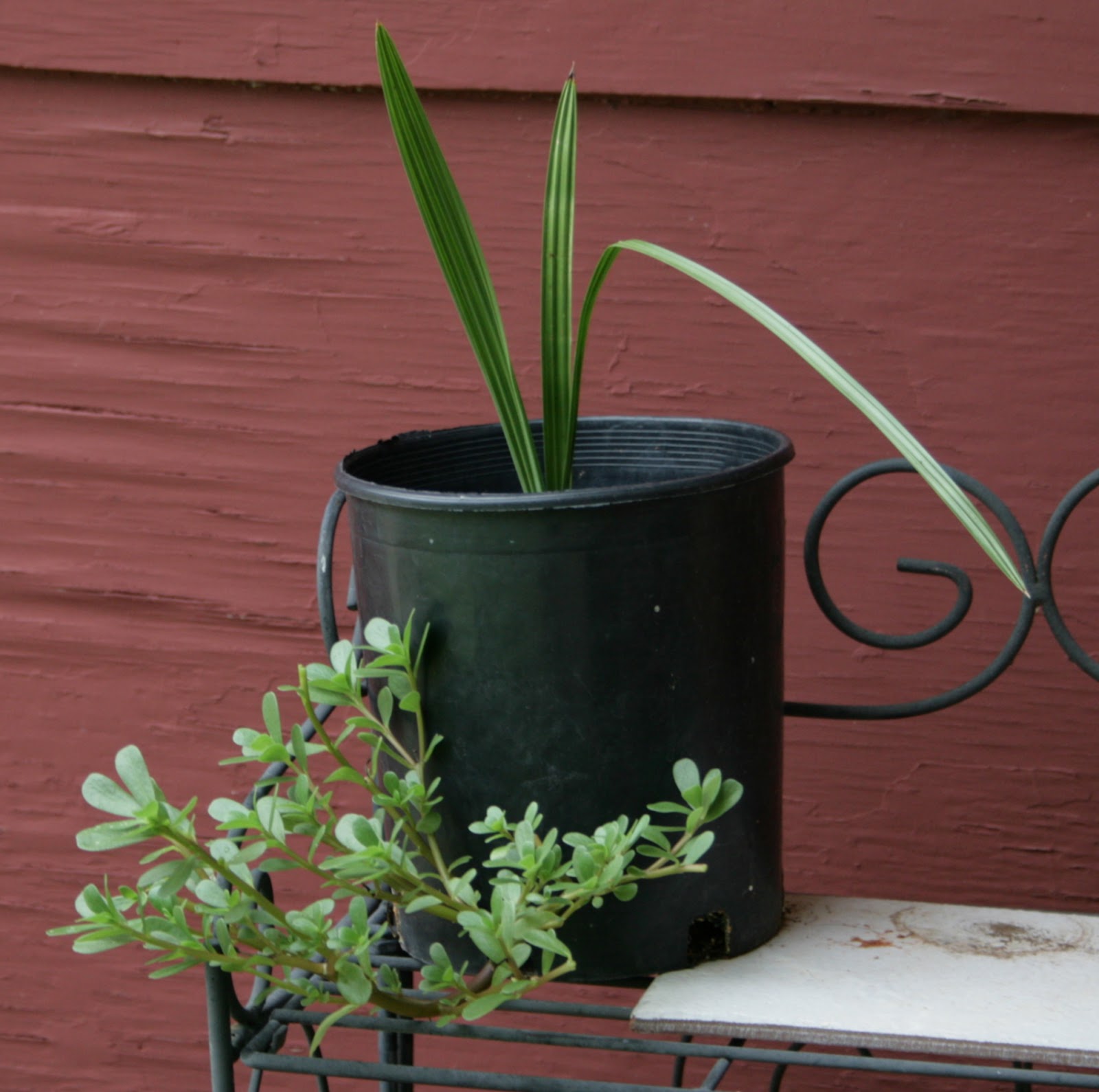
Medjie the baby Medjool date palm growing in a pot in Oklahoma


Isn't he/she so cute?!?
I think I will name him/her Medjie.

Now you are probably thinking "big deal" in some sort of sarcastic thinking tone.  And you are probably wondering what it is.

It's a baby Medjool Date Palm Tree!

I travel to Israel every winter for a few weeks, and I always bring home Medjool dates as gifts for various people (and some for me).  They are SO yummy!

Well, I forgot that I had spit two of the pits into a tissue and put them in my handbag.  I found them in April, and rather than just throw them into the trash, I decided to keep them and maybe plant them and see if I could get them to sprout.

So I planted them both together in this little clay pot at the end of May.
And look what popped up about 2 weeks ago!  (Talk about slow-growing!)

There is no sign of the second one, but one is enough excitement for now.  I don't know what I'd do with twins!  I wouldn't know where to buy matching outfits for Medjool Date Palm babies.

As soon as I saw that little head breaking ground, I went Googling to find out all I could about how to raise a Date Palm baby.

Well....let me tell you.  If I knew how complicated this would be, I might not have planted that seed.
No, I'm sure I would still have planted it.

But, what I discovered is that Medjool dates are so expensive and so yummy because of all the hard work that goes into pollinating and thinning them out.
First of all, this baby tree will either be a boy or a girl (maybe I should call them by the correct botanical names - either male or female).
No problem so far.  I wait and see if my tree produces pollen or flowers.

Then I read more...turns out that most good Medjool Date Palm Trees are grown as suckers from the root and trunk of the parent tree.  Seeds are never used to produce good Medjool Date Palm Trees.

Okay, so now I know I don't have to worry about waiting to see if the tree grows to produce a 10 pound pollen sheath or loads of flowers.
And I don't have to wait for another seed to sprout that happens to be the opposite sex of my baby tree.  And I don't have to wait years for them to grow old enough to reproduce.
And I don't have to collect the pollen from the sheath and thin out most of the flowers and pollinate each flower by hand.
And I don't have to move to the desert where cold winters won't kill my baby tree.
And there is so much more to this trick of growing Medjool Date Palm Trees.
(check it out online for yourself - it's actually quite fascinating!)

Now I can just be content knowing that I am raising a baby that will never grow fully and will never produce babies.  And I will be content knowing that my baby will have to stay in a pot and come inside every winter.  I will just watch him/her grow (slowly!) week by week and enjoy the fact that one of my Medjool date seeds actually sprouted!!


In my amazement at this sprouting, I must also share a sprouting much more amazing and formerly thought impossible (so now you know there is no way the sprouting was done by me!).

During my winter trip to Israel in 2012, my tour group visited a kibbutz named Ketura in the Arava Desert.  They grow many innovative crops (including crops of a special kind of algae).
They also provide the permanent home for Methuselah.

I'm not talking about the old bones of the very old man in the Bible.
I'm talking about the young bones (fronds) of the very old seed of a date palm from the Masada excavation.
That makes it about 2000 years old (but just a few years since the sprouting).

Here is a photo of Methuselah in 2012 (with the tour group members erased as much as possible - sorry for sloppy look).

Methuselah


Apparently they have discovered that Methuselah is a male (appropriately), and they hope to use his pollen to pollinate females to end up with a date palm with characteristics from a heretofore extinct date palm tree!

You can read more about Methuselah at the website of The Arava Institute.
And if you would like to read more about what Kibbutz Ketura is up to, check out their website.


Here is one more photo from my trip to the kibbutz. This is looking at one of their current date palm groves from inside the grove.  If you look closely you should be able to see two dots at the base of a tree.  These two dots are actually two donkeys eating weeds in the grove (and applying a fertilizing mulch).  That's how huge these trees are!


Now back to Oklahoma....
Before I put the babies to bed, I would like to share a few more baby photos from my nursery (pun intended).

baby wisteria in Oklahoma


Wisteria...now in it's second year.
One of the people I do some gardening work for gave me this as a 3 inch tall runaway sprout coming up in his lawn.  I'm going to keep it potted and see if I can do a large bonsai/small Wisteria tree.


runaway blackberry sprout rescued from the lawn


And speaking of runaways...this is a 3-month old lawn shoot-up from my landlady's prolific blackberry bush.  These shoots pop up 5 and 10 feet from the mother bush, in the middle of the lawn.  They usually get mowed over, but sometimes I uproot one and pot it to give away as a starter.

My parents have a large thriving bush from one of these lawn-starters.

This one is going to its new home tomorrow...one of my gardening customers would like to have it.


One more....

Ruellia

These are sprouts of Mexican Petunia (Ruellia), the dwarf clumping kind.  They also came from a gardening customer.  I love these plants for Oklahoma. They do well in the heat and the dry summers.  They seem to overwinter just fine.  And the purple blooms and spiky dark-green leaves are a great combination.
Oh, and those little plants surrounding the Mexican Petunia?  Those are baby purslane seedlings...I have thousands of them!

But purslane will have to wait for its own post later - it's one of those great edible weeds!

I have a few more babies in the nursery, but these are all the photos I have at the moment.
And it's bedtime (at least for me...been a long hot day), so I will say good night.

Thanks for letting me share photos of my babies!